
Kids love the great taste of peanut butter, and school nutrition professionals love the protein and other key nutrients of this American staple. Some schools, however, struggle with managing peanut products due to concerns about food allergies. Others are unsure of how to safe use peanut butter as an ingredient in meals beyond the typical PB&J. Here are answers to top questions about peanut products in school from Chef Garrett Berdan, RDN, and Dayle Hayes, MS, RD.
When it comes to managing food allergies, what resources do you recommend for school nutrition pros?
Garrett: Two main resources that I recommend are the Institute for Child Nutrition’s training on food allergy management, and the Center for Disease Control and Prevention Food Allergies in Schools Toolkit. Also, resources that are available linked from PeanutAllergyFacts.org, including training videos for school nutrition professionals.
How can school nutrition pros leverage the culinary versatility of peanuts and peanut butter to help improve school meals?
Garrett: If we can look at it as a protein component to serve on the side with some dippables, that’s always a fun thing for especially younger kids to enjoy. That could be any variety of fruits for dipping into peanut butter. From apples and pears and banana, but also think of peanut butter as a dip for veggies like carrots and celery, and even bell pepper strips.
The flavor of peanuts is really on trend now in cuisine that we see outside of schools. Certainly, with Southeast Asian flavor profiles, peanuts and peanut sauce are an important flavor aspect of those cuisines. Those can be easily integrated onto a school menu with dishes like noodles with a peanut sauce, or maybe a chilled veggie and noodle salad. That definitely takes things beyond the peanut butter and jelly.
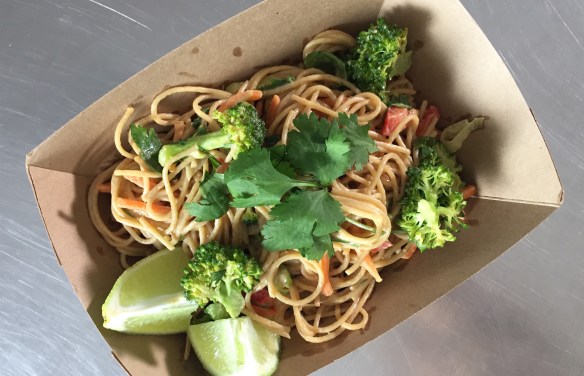
Peanut Sauce with Noodles: Recipe video available at goo.gl/qx3aJn
What is your favorite preparation for peanut butter being used in school meals?
Dayle: The thing that I’m most excited about is what people are calling power packs or grab and go meals. The ones I’ve seen often include an individual container of peanut butter along with pita bread, pita chips, or whole grain crackers. Then some sliced apples, maybe some baby carrots or celery sticks, and often an added protein source like a cheese stick.
How does peanut butter help lower costs for school nutrition programs?
Dayle: School nutrition programs are very limited in terms of overall food costs and often pennies per serving can make a difference in balancing budgets. For consumers and foodservice channels, peanuts and peanut butter are often always listed as one of the least expensive protein sources. It compares so favorably with the cost of other proteins. When you reduce the cost of the meat or the meat alternate in the “center of the tray,” then you have more food dollars for fresh produce and other local items. Farm to School is one of the fastest growing areas of school nutrition programs and any money that directors have to spend in purchasing local products works to their benefit.

What nutritional benefits do peanuts and peanut butter provide for school aged children?
Dayle: Protein is one of the most obvious nutritional benefits of peanuts and peanut butter for children. The unsaturated fat plus the protein provides satiety in a meal or snack. Peanut products can offer an extended source of energy for children’s physical activity and for their brain activity too.
In addition to protein, there are three other nutrients that I always think about in terms of school-age children. One is potassium. Potassium is one of the nutrients of concern that health experts know we’re not getting enough of for our everyday needs, and peanut butter has potassium in it. In fact, one serving (one ounce) of peanuts provides 6 percent of the daily value and one serving (2 Tablespoons) of peanut butter provides 5 percent of the daily value. Also, peanut butter pairs well with some other kid-friendly, high potassium foods like apples and celery.
Peanuts and peanut butter are also a source of fiber as well. One serving of peanuts contain 10 percent of the daily value and one serving of peanut butter has 8 percent of the daily value. Because most of the meat alternate foods do not have any fiber in them, this combination of protein, potassium, and fiber is great.
The other nutrient in peanuts and peanut butter I want to mention is iron, because in the recent Dietary Guidelines for Americans, the Scientific Advisory Committee called out iron as a nutrient of concern for girls and young women. One serving of peanuts provides 7 percent of the daily value and one serving of peanut butter provides 3 percent of the daily value. Any time we can find a source of iron that students like to eat it’s a win-win situation in terms of their nutrition.

Preparing Peanut Butter and Jelly Sandwiches in School Foodservice: Video at goo.gl/kuNiIk



 School Meals That Rock