Comfort Food: Please pass the peas – and the love

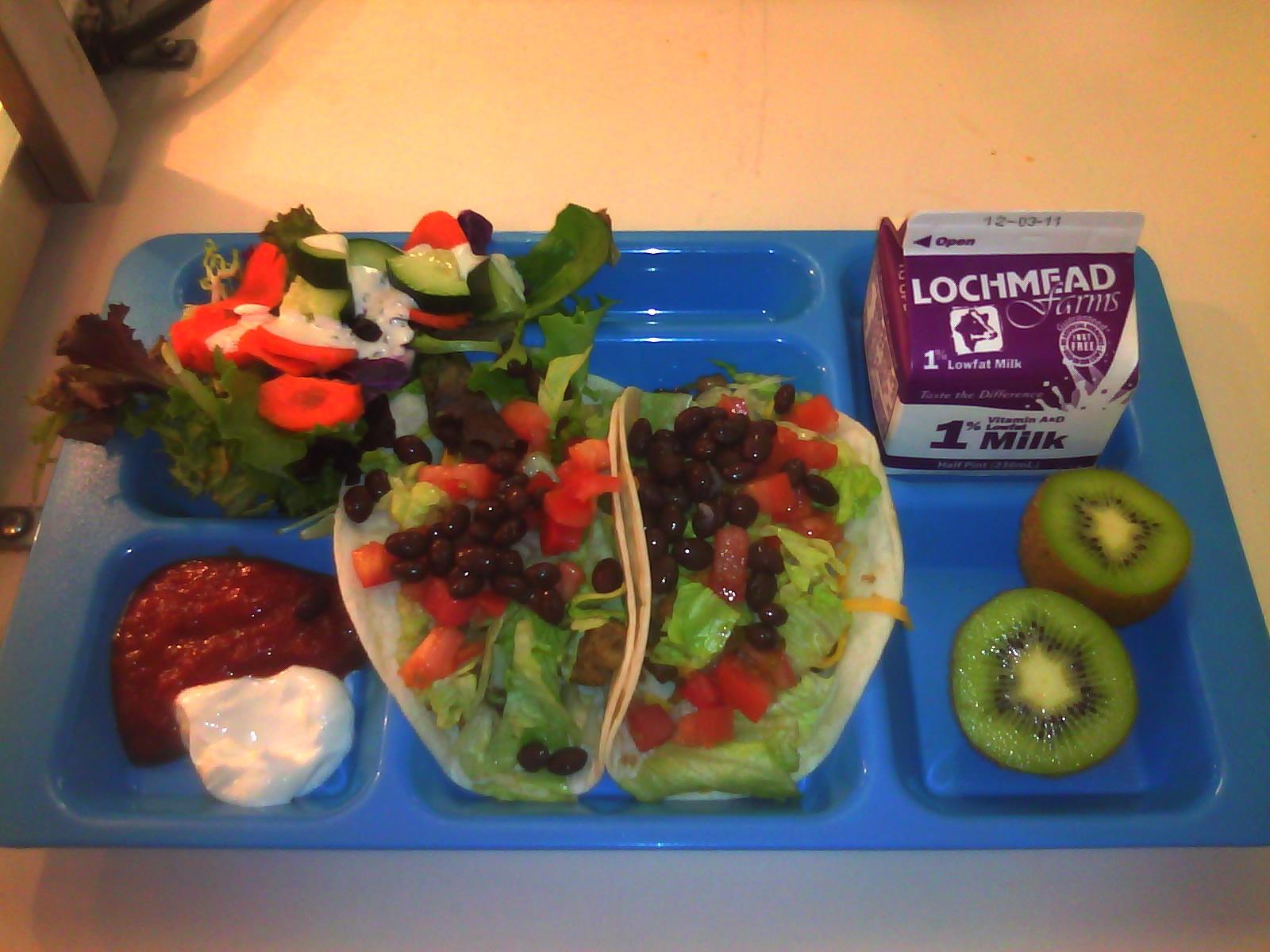
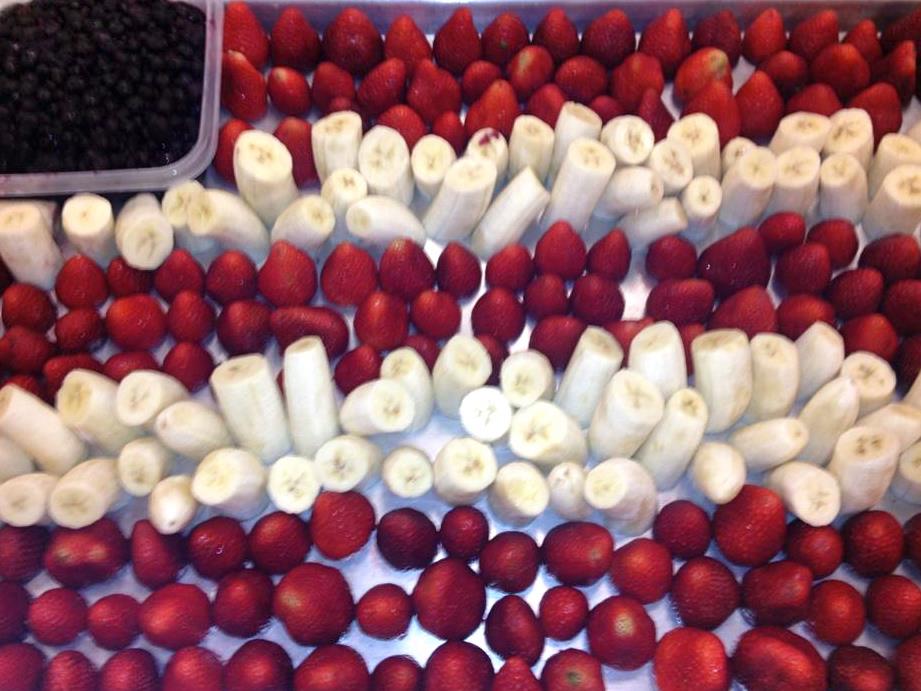
This column was originally published in the Billings Gazette, seven days after 9-11-01. This gorgeous photo is from 9-11-12 at Timpanogos Elementary Lunch Line, Provo, Utah. 
“Food to a large extent is what holds a society together and eating is closely linked to deep spiritual experiences.”[Peter Farb in Consuming Passions: The Anthropology of Eating, 1983]

When I wrote my Nutrition News column last week, the world was a different place. The events of September 11, 2001, have left our lives more complicated, intensely painful, and very uncertain.

At this point, to continue writing about sugar and health seems trivial and unrelated to the rhythms of life after such a disaster. As I move back and forth through shock, anger, fear, sorrow and hope, I – like all of you – am trying to put this tragedy into the context of my work and my family’s life.

I believe that food, and nutrition, have important roles in our lives as we move through personal grief, national tragedy, and global insecurity. I began to realize what these roles might be on Friday, the National Day of Remembrance and Prayer.

Through what seemed like a river of tears, I invited friends to dinner and began to make bread – to make bread by hand, not by machine. In kneading dough, baking bread, preparing dinner and setting the table, I began to feel calmer and more settled – the solace of simple things in troubled times.

Since then, I have listened carefully to wise thoughts from religious leaders, poets, counselors, musicians and others. Many themes for healing, recovery and “getting back to normal” begin to emerge. Some words are mentioned repeatedly – family, ritual and community among them.

Many people have also spoken of reordered priorities, of reminders of that which is truly important, of refocusing our lives on those things that really matter. Naturally, from my nutrition perspective, all these themes keep bringing me back to food.

In terms of food, the important things are the simple things: meals prepared for loved ones; nurturing food given generously; homegrown produce eaten in the garden; and bread, the staff of life, broken together. In the words of the wisest dietitian I know, Ellyn Satter: “Eating is about regard for ourselves, our connection with our bodies, and our commitment to life itself.” [Secret of Feeding a Healthy Family, Kelcy Press, 1999]

My nutrition thoughts today are not about what to eat, but about how to eat. Since the beginning of human culture, eating together has been important to families and communities – and the rituals that bind us together.

Think about those words – and special meals come to mind. Holiday meals like Thanksgiving and Passover, shared meals like church potlucks and office parties, celebratory meals like birthdays and anniversaries.

Unfortunately, in our fast food culture, everyday meals have too often been seen as something to get through quickly – so that we can get on to something more important. In this troubled time, as we search for a sense of safety, there may be nothing more important than rediscovering the joy and security of good food eaten with others.

As we face the uncertainty of the future, cooking and eating together are among the simple things that can comfort us. The strength we seek, as well as nourishment, health, communication, and stronger family bonds, are as close as our kitchens and dining rooms. Here are a few ways to make food and nutrition even better than “normal” in the weeks ahead.

  • Cook together. Preparing food is a loving way to share time and bring generations together. Measuring, stirring, and chopping can be as comforting as other routine, everyday tasks. Kneading bread can be downright therapeutic.
  • Eat together. Make family meals a real priority as often as you can. If you live alone, reach out to family, friends, or co-workers – and break bread together. Eat together at home, eat together at restaurants, eat together at work, eat together at a picnic.
  • Turn off the television. Even in normal times, television makes it hard to eat well. The repetitive images of recent destruction can literally make us sick to our stomachs. Take a break from the news and focus on the tastes, smells and textures of food.
  • Return to rituals. Families have many rituals for meals – prayers, a moment of silence, joining of hands, candles, or festive touches, like flowers and special dishes. Making rituals part of everyday meals ties us to the past and to hope for the future.
  • Take time to share. Slow down and share – food, fellowship, memories, tears, laughter, and the joy of time together. Even small children can learn to share in conversations at the table. Give everyone time to share what is important to them.
  • Invite others to join you for a meal. A sense of community is one of the strongest ways to fight fear and move forward. By joining with others around the table, you can begin to take comfort from the nourishing food and loving companionship.

Eating is not merely a material pleasure. Eating well gives a spectacular joy to life and contributes immensely to goodwill and happy companionship. It is of great importance to the morale.” [Elsa Schiaparelli, Shocking Life, 1954]

#ThinkFood with Dayle Hayes, Child Nutrition Leader and Blogger

This was originally posted on the The Dairy Report on September 5, 2012. I really appreciated the opportunity to participate in the Colorado Future of Food conversation and was honored to chat in more depth with Jean Ragalie. 

As Karen Kafer discussed in an earlier post, the dairy team hit the road this summer to participate in “Future of Food: Food in the 21st Century,” a solutions-oriented discussion on food security. Our journey began in Washington, D.C., then continued out west, in Colorado and Arizona, and returned back to the east coast with a summit in Vermont late July. At each summit, I met with various leaders in agriculture, education and government and learned more about dairy’s role in the larger conversation about food security.

At the Colorado event, I was given the opportunity to chat with featured summit speaker and School Meals That Rock creator, Dayle Hayes, MS, RD, about her experiences as an event speaker and her thoughts on the future of child nutrition. I’ve included some of our conversation below. In the meantime, I hope you join the discussions online with #ThinkFood and tune into the next summit, scheduled for October 3 in Chicago, with the Midwest Dairy Association!

Jean Ragalie (JR): What was your biggest takeaway from the event in Denver?

Dayle Hayes (DH): The time when I was reminded of what Harry Truman said when signing the first National School Act in 1946: “In the long view, no nation is healthier than its children, or more prosperous than its farmers.” It was also interesting that speakers’ comments reinforced this over and over again from different vantage points throughout the event.

JR: With regard to child nutrition, what have you seen really work and create change over the past decade?

DH: I believe that it takes a combination of three factors:

  1. Government regulations and incentives, like the HealthierUS School Challenge
  2. Product innovation, like flavored milk, and food system changes, like more local foods in quantities
  3. Local school champions, like those involved in Fuel Up to Play 60 (FUTP 60). I can say in my experience, the dairy industry programs and education of all kinds, including FUTP 60, have made a game-changing contribution to the process.

JR: What is the role of school systems in child nutrition?

DH: Essential, obviously. However, for too long, many districts have seen school meals as an irritating necessity. Clearly, the “herd ‘em in, ‘herd ‘em out” mentality is not conducive to dining enjoyment and to trying new foods. Schools must see the cafeteria as equal in importance to the classroom. Otherwise, the new meal patterns will have little sustainable effect.

JR: What are the latest tools available to help improve child nutrition?

DH: New regulations, new products and new programs are important to help improve child nutrition. The 2012 Meal Pattern update will have tremendous implications for child nutrition programs. New products from dairy companies are making it easier to serve tasty, healthful choices. Many national and local organizations provide grants of all sizes to school nutrition programs for training, equipment, and implementation. FUTP 60 is one national example, and there are literally hundreds of others. If a school wants to make improve their nutrition program, there are resources to help them.

JR: If you’re concerned about child nutrition as a health or nutrition professional, what should you do to make a difference?

DH: Partner with the professionals in your school who are also interested in (and required to make) changes with the new regulations. Help your school get the resources they need to make system-wide changes and support the nutrition program within the school and community.

Flavored Milk Update: Let’s focus on what’s important in school nutrition

As a Registered Dietitian (RD) who has dedicated over 30 years of my work and volunteer life to child nutrition, I am astounded that some folks are still focused on banning flavored milk from schools. When I was asked my opinion on banning flavored milk yesterday, I had to update my 2011 column about The Flavored Milk Wars: Is a tempest in a milk carton good for kids’ nutrition? Full Disclosure: I am proud to work with the dairy farm families represented by National Dairy Council and regional dairy councils, such as Western Dairy Association.

Really? Now? When schools need all the help that they can get to roll out historic and challenging new regulations? Our time is better spent collaborating on getting more red/orange/dark green vegetables into kids instead of trashcans, on developing plans for school garden, or a campaign to get more calcium into young people, especially tween and teen girls.

First, let’s look at the state of flavored milk served in schools today. This is not a “milkshake” in a plastic bottle nor the flavored milk that you drank in school. In the past six years, the dairy industry has responded to nutrition concerns and renovated their products dramatically:

  • From 2006 to 2012, the average calories in school flavored milk decreased by 34 calories – to around 130 calories in 8 ounces. This is only about 40 more calories than fat-free white milk.
  • Decreasing calories has been accomplished by reducing fat (to fat-free milk) and reducing added sugar. Added sugar in flavored milk has declined by 40% – by over 6 grams per cup – during the past 6 years.
  • Many dairies now offer fat-free flavored milk with just 10 to 12 grams of added sugar per cup. Some anti-flavor activists fail to remember all milk has 12 grams of natural sugar (lactose) straight from the cow!
  • Now, the fat-free chocolate milk served in many schools across the country has 130 calories, 0 grams of fat and saturated fat, and 22 grams of total sugar. That’s 12 grams from naturally occurring lactose and just 10 grams or 2½ teaspoons of added sugar. 

Next, let’s keep our eyes on the prize – children’s overall health. While some children in the US are getting too many calories for their activity level, a significant number of children are seriously under-nourished. The 2010 Dietary Guidelines for Americans listed four nutrients of concern for adults and children: calcium, vitamin D, potassium, and dietary fiber. These nutrients are “of concern” because our low consumption can affect our health today and in the future. Here‘s how nutrients of concern relate to the flavored milk debate:

  • Just like white milk, flavored milk provides three of the nutrients of concern – all of them except dietary fiber.
  • All milks are nutrient-rich beverages. They are packed with what kids need for strong bodies – calcium, vitamin D, and potassium, as well as protein, phosphorus, and vitamins A, B12, riboflavin, and niacin.
  • Milk with school meals – unflavored and flavored – is one of the easiest, least expensive ways to close the gap on nutrients of concern.

Finally, let’s figure out how to work together for optimal school nutrition. Improving child nutrition in the US requires collaboration – among parents, dietitians, chefs, and school nutrition professionals. Right now, school nutrition programs are focused on meeting the new standards mandated by the 2010 Healthy, Hunger-Free Kids Act. Honestly, the challenge is not serving healthier foods (more veggie variety, more fruit, more whole grains) – it is insuring that all this nutrition gets into kids not into trashcans.

Banning flavored milk might have the potential for a tiny reduction in calories. However, several national and local studies have confirmed that it is also likely to reduce overall milk consumption. Is this really a smart strategy? Do we want more milk – with all that calcium, vitamin D, potassium, and other nutrients – going into trashcans instead of undernourished kids?

No one – not even the dairy industry – is suggesting that we should push flavored milk at kids. Let’s have fat-free flavored milk as one option in the school cafeteria. Let’s not throw important nutrients out with misplaced concerns about small amounts of sugar.

Let’s put our passion for child nutrition toward effective collaborations improving access to delicious nutrient-rich, more-locally sourced foods at school and at home. Let’s get together on School Gardens, local Farm-to-School projects, and helping kids build “Best Bones Forever.”

USDA New-trition Guidelines for School Meals: Business as usual – or whole new ballgame

On January 26, 2012, USDA released the long-awaited 2012 Nutrition Standards in the National School Lunch and School Breakfast Programs.  According to the website: “Through the Healthy, Hunger-Free Kids Act championed by the First Lady and signed by President Obama, USDA is making the first major changes in school meals in 15 years, which will help us raise a healthier generation of children.”

As students head back-to-school meals in cafeterias across the nation, the new standards are generating lots of media buzz with headlines like Schools scrambling to serve up healthier lunch choices, More vegetables, higher prices coming to school cafeteria lunch lines this fall, and Some Cocke County students finding new school lunches hard to swallow. From these news stories, it’s clear that the new guidelines are, sadly, a new whole ballgame for some districts.

The really good news for hungry children, their families and educators is that many schools have been working towards the very same science-based standards for years, even decades. This is especially true for the 3,871 schools that have met the criteria for a HealthierUS School Challenge (HUSSC) award, a strategic component of Michelle Obama’s Let’s Move! initiative. This impressive achievement is a strong indication of how committed school nutrition professionals are to offering students the healthiest meals possible:

“In February 2010, the First Lady and USDA challenged stakeholders to double the number of HUSSC schools within a year and add 1,000 schools per year for two years after that. We exceeded our first goal last June and this year we’ve again exceeded expectations. Not only have we surpassed our second year goal we’ve more than met our goal for June 2013 a year ahead of schedule!

How often does “ahead of schedule” happen in the real world!! Here are some of the key changes what will show up in some schools – and will be just business as usual in many other districts:

MORE VEGETABLE VARIETY

Schools are now required to serve a wide-variety of colorful vegetables each week. Additionally, in order for a lunch meal to be reimbursable, each tray will need to include at least ½ cup of fruits and/or vegetables. This will be easy in districts like Lake Stevens, Washington, where students make a “rainbow at the salad bar.”

MORE FRUIT

Students must now be offered a fresh, frozen, dried, or canned (in juice) fruit for lunch. In the Montague, Michigan, School Food Service Department, they serve fruit choices daily on the lunch line. Michigan apples are so popular that Montague set a 2011 Guinness World Record for eating 9,329 apples at the same time.

MORE WHOLE GRAINS

As per the new standards, at least half of all grains served in school lunch must now be whole grain rich (starting in 2014 all grain products must be whole grain rich). In Douglas County Schools, Colorado, they made popular pizza smarter with a whole grain crust, roasted vegetables, and a balsamic glaze (chosen by a high school student panel).

ONLY LOW-FAT and FAT-FREE MILK 

Under new USDA guidance, schools must offer two varieties of milk: unflavored milk can be non-fat or 1%, while flavored milk must be non-fat. This milk policy has been the standard in Portland (Oregon) Public Schools Nutrition Services for more than a decade. As you can see, they also offer a colorful selection of produce!

Other mandated changes for school lunch meals include:

  • Calorie ranges for three grade groupings (K-5, 6-8, and 9-12)
  • Minimum and maximum servings per week for both grains and meat/meat alternates (cheese, beans, etc.) for each of the grade groupings

New-trition on a School Lunch Tray: What Would Julia Say?

Two things have been top of my mind recently: First, as students head back-to-school, USDA’s new guidelines for school meals have begun to “hit the trays” in cafeterias nationwide. Secondly, foodies everywhere have been celebrating the 100th birthday of Julia Child’s with a veritable banquet of of quotes, tributes and reminiscences.

While I know that Julia Child commented on fast food (in fact, we agree that In-N-Out Burger is our favorite chain), I cannot find any specific opinions she expressed about school lunch. Perhaps that’s because national attention was just beginning to focus on school food when she passed away in 2004. However, based on several of her famous quotes, I have decided that Julia Child would be quite pleased with current school food trends – and would admire the work of my favorite school nutrition heroes as well.

You don’t have to cook fancy or complicated masterpieces – just good food from fresh ingredients. This simple salad from the Power-Up Cafe at Cypress-Fairbanks ISD just outside Houston, Texas, elegantly illustrates the trend toward fresh ingredients in schools. The staff included Romaine lettuce, carrots, tomatoes, jicama and chickpeas (tossed in a chili lime seasoning) to meet the new guidelines for greater vegetable variety on school lunch trays. Now, all they need is a name for the salad; so far my vote is with Chicka Chicka Boom Boom. I wonder what Julia would have called it – besides gorgeous!

How can a nation be called great if its bread tastes like Kleenex? I know that Julia would have loved Peggy Lawrence, Director of Food Services in Rockdale, Georgia (and the 2012 Georgia SNA Director of the Year). In her district of 16,000 students, many whole grain bread products are baked in each school’s kitchen. Peggy knows that the aroma of made-from-scratch, no-Kleenex-here cinnamon and sandwich rolls brings students and staff into the cafeteria for freshly baked, whole grain goodness. It also helps her menus exceed the new standards for half of all grains products to be whole grain this year.

Peggy and Julia would certainly agree that “… no one is born a great cook, one learns by doing.” That’s why Peggy and other savvy directors spend plenty of training time – in groups and one-on-one – to insure that the best possible products are served in their schools. From coast-to-coast, school nutrition professionals have been upgrading their culinary skills to roll out the complex USDA Nutrition Standards for School Meals, with colorful eye-appleaing menus and the nutrient-richness that children need – minus the excess fat, sodium and sugar that they can do without.

This is my invariable advice to people: Learn how to cook – try new recipes, learn from your mistakes, be fearless, and above all have fun! School nutrition professionals have a very important – and very tough – job. They have to meet the new federal standards on minimal budgets (often about $1.00 per lunch for food). They have to satisfy the taste buds of a generation that has grown up on fast food, chicken fingers and pizza. They have to serve hundreds (or even thousands) of students in crowded cafeterias quickly and efficiently. They face criticism from all sides – everyone from principals and parents to TV chefs and teachers thinks they know more about school meals that people who actually prepare and serve them.

And yet, like these smiling professionals at an August 16th back-to-school training in Provo, Utah, they are eager to learn new skills and proud to serve children the safest, most nutritious, best tasting meals possible. They may be a tiny bit fearful about the increased scrutiny that the new lunch guidelines will bring, but I can guarantee you that they know how to have fun! I believe that Julia Child would indeed be proud of these professionals who are “Moving in the Future” and ready to help a generation become fit, healthy, and ready to succeed!

New School Meal Patterns: Do U Have 2 B a Magician?

Delighted to be in Denver for the School Nutrition Association’s 2012 Annual Nutrition Conference – where 6,000+ school food professionals come to taste new items, check out the latest equipment, and listen to the best speakers in the business. Like my colleagues from every state and several foreign countries, I am here to learn, learn, LEARN!

The focus of this meeting is quite clear: Everyone involved in school nutrition is eager (desperate might be a better word) for answers about the rollout of USDA’s 2012 Nutriton Standards for School Meals. The complexity of the meal pattern changes and the questions about students’ reactions can be summarized in a friend’s Tweet from the conference yesterday: “U dont have to b a ‪#dietitian‬ 2 meet the new school guidelines, u hav 2 b a magician”

Here are three “magic wands” that I’ll be looking for at the conference sessions and exhibits: (1) What products and recipes will meet the new meal pattern AND student taste preferences at the same time?

The Zesty Chipotle Chicken Flatbread tray pictured above meets the new meal pattern and fits well into current reimbursement levels. It has also been kid-tested in the Denver Public Schools. I tasted it last night – and loved it. But, many issues still remain in serving trays that meet the new meal pattens:

  • Chipotle (or flatbread for that matter) will work great in some parts of the county and fall flat in others. Where are the hundreds (maybe thousands) of recipe/meal options necessary to please critical students and fit the guidelines?
  • Some of the toughest new requirements are serious restrictions on grains (even whole grains) and meats (even lean ones). Were such restrictions necessary given the new calorie ranges for three age groups (K-5, 6-8 and 9-12)?

(2) What do we need to market/promote/inspire students and staff to ENJOY (in some cases) radically different school meals meals?

It’s pretty safe to say that the vast majority of US children are not currently following the USDA Nutrition Standards when eating at home or in restaurants. It’s going to take some serious marketing and promotion to get the beautiful new meals into kids rather than garbage cans.

  • The staff in Lake Stevens Washington did a FABULOUS job with their “Make a Rainbow at the Salad Bar” promotion. What else are schools doing effectively to motivate kids to enjoy foods they may never have seen before?
  • Marketing and promotion take time, resources, and expertise not always available in school nutrition programs. How are school training staff, finding resources, and collaborating to get the job done?

(3) What can we do create CAFETERIAS that provide positive, pleasant places for students to learn healthful eating habits?

The current “herd ’em in, herd ’em out” mentality in many school cafeterias is not an environment that encourages trying new items and enjoying a variety of flavors on your tray. One school lunch director told me that kids in her school have so little time to eat that “they are still grabbing things off trays while walking toward the trash cans.”

  • Since it’s only nutrition when they eat or drink it, we have to give more time and attention to school meal environments. With all the focus on WHAT is being served, we can not WHERE, WHEN, and HOW school meals are served. 
  • As long as these conditions are less than optimal, we will be feeding garbage cans not kids. I am deeply interested in WHAT schools are doing to address these issues.
STAY TUNED here and on FB SchoolMealsThatRock and Twitter SchoolMealsRock for everything that I learn here in Denver!!

For a True School Nutrition Hero: A Letter of Reference

To Whom It May Concern:

It is with great pleasure that I write this letter of recommendation for Doreen Simonds, currently Manager for Nutrition Services in the Waterford, Michigan, School District. I have interviewed Doreen multiple times over the past several years and carefully followed her outstanding work in Waterford. Ms. Simonds’ program has been featured in many of my presentations, as well as in several pieces that I have written for the School Nutrition Association (SNA). These include the 2011 Make Fuel Up To Play 60 Work For Your School Nutrition Program toolkit and mostly recently a June 2012 article for SNA’s Magazine on Putting the Power of Fuel Up to Play 60 to Work for YOU.

Without a doubt, Doreen Simonds is a true school nutrition hero and one of the leading school nutrition directors in Michigan today. Any district would be lucky to have her unique combination of professional dedication, business savvy, and programmatic creativity. As 25+ year nutrition veteran in Waterford, she oversees school meals and other nutrition programs in twenty buildings for an enrollment of nearly 12,000 students – and with exceptional enthusiasm. Here are three of the many reasons that I recommend Doreen for a position in your district.

First, COMMITMENT to children: In Doreen’s world, it really is all about feeding hungry kids. In describing her first venture into USDA’s Summer Food Service Program (SFSP) this year, she wrote: “We really pulled together the SFSP in a huge rush (we just applied to do it under a month ago). I felt compelled not to wait and did a huge push for it. Every time a mother comes up to me with tears in her eyes and says  “I don’t know what I was going to do this summer to feed my kids…thank you so much for doing this!”  I know the struggle was worth it!!!

Secondly, CREATIVITY in marketing: Everything that Doreen does is infused with creativity. Her talents, abilities, and 30+ years as a wedding photographer all come together in the positive brand she has created with the WSP Depot Cafe, its life-sized mascot Diggin Diesel, and the Tracker Tray Train, designed to help kids understand and enjoy all the components of nutritious, delicious school meals. It’s no wonder that Waterford’s maintains impressive levels of participation – and that Doreen’s district has been recognized with multiple HealthierUS School Challenge awards, as well as an invitation to celebrate with Michelle Obama on the lawn of the White House (Doreen is fourth from left).

Finally, COLLABORATION with others: Every time I talk to Doreen Simonds, I hear much more about the folks she works with than about her. This is a woman who clearly knows how to “play well with others.” She takes advantage of every opportunity to collaborate with other programs, like Michigan Team Nutrition and Fuel Up To Play 60. She is always eager to talk about how her successes are the result of others hard work: “In Mason Elementary, we have a teacher ‘champion’ who goes all the way, so we have 60 to 80 kids at the monthly meetings. We’ve seen a huge increase in breakfast and lunch participation – and their fruit intake is unbelievable! The kids have helped with taste tests, like whole grain waffles, and United Dairy Industries of Michigan provides super support and lots of wonderful materials.”

Seriously and sincerely, Doreen Simonds is a school nutrition hero and you want to have her on your team!   Dayle Hayes, MS, RD


Time to Move Beyond the Chocolate Milk Wars

New research published in the June 2012 issue of The FASEB Journal, a prestigious scientific publication, confirms what many of us have been saying for a long while: Flavored milk is not associated with excess weight gain in children and adolescents. The researchers, headed by Dr. Connie Weaver at Purdue University conclude that “flavored milk should not be removed from school cafeterias because of the perception that it contributes to childhood obesity.”

As a Registered Dietitian (RD) who has dedicated more than 30 years of my work and volunteer life to child nutrition, I have been bewildered by the intensity of efforts to ban flavored milk from schools. Petition drives, community forums, hyperbolic sound bites – really? Is this all about 10 or 12 grams of sugar? I wonder if these confrontational tactics are best the thing for improving children’s nutrition. Might our time be better spent collaborating on a school garden, a salad bar, or a campaign to get more calcium into kids?

First, let’s take a look at the facts about the flavored milk served in schools today. This is not a “milkshake” in a plastic bottle nor the flavored milk that you drank in school. In just the past five years, the dairy industry has responded to nutrition concerns and renovated their products dramatically.

• From 2006 to 2012, the average calories in flavored milk decreased by 30+ calories – to just under 134 calories in 8 ounces. This is only 31 more calories than white milk.
• Decreasing calories has been accomplished by reducing fat (to fat-free milk) and reducing added sugar. Added sugar in flavored milk has declined by 38% – by 6+ grams per cup – over the past 5 years.
• Many dairies now offer flavored milk with just 10 to 12 grams of added sugar per cup. Some anti-flavor activists fail to remember all milk has 12 grams of natural sugar (lactose) straight from the cow!
• For example, the fat-free chocolate milk served in New York City public schools has just 130 calories, 22 grams of total sugar, that’s 12 grams from naturally-occurring lactose and 10 grams of added sugar.

Next, let’s keep our eyes on the nutrition prize. While some children in the US are getting too many calories for their activity level, a significant number of children are seriously under-nourished. The 2010 Dietary Guidelines for Americans listed four nutrients of concern for adults and children: calcium, vitamin D, potassium, and dietary fiber. These nutrients are “of concern” because our low consumption can affect our health today and in the future. Here ‘s how nutrients of concern relate to the flavored milk debate:

• Just like white milk, flavored milk provides three of the nutrients of concern – all of them except dietary fiber.
• All milks are nutrient-rich beverages. They are packed with what kids need for strong bodies – calcium, vitamin D, and potassium, as well as protein, phosphorus, and vitamins A, B12, riboflavin, and niacin.

Dr. Rachel Johnson (University of Vermont professor and former dean) has studied milk consumption for years. Co-author of Drinking Flavored or Plain Milk Is Positively Associated with Nutrient Intake and Is Not Associated with Adverse Effects on Weight Status in US Children and Adolescents in the April 2008 Journal of the American Dietetic Association, Johnson has noted that “the battle against chocolate milk may be the wrong one.” I agree completely – and this new study is one more important reason to end the chocolate milk wars!

Finally, let’s figure out how to work together to improve nutrition in schools and for families, especially those in low-income, at-risk neighborhoods. Improving child nutrition in the US is going to take serious collaboration – among parents, dietitians, chefs, and school nutrition professionals.

Banning flavored milk might have the potential for a tiny reduction in calories. However, several national and local studies have confirmed that it is also likely to reduce overall milk consumption. Is this really a smart approach? No one – not even dairy advocates – is suggesting that we should push flavored at kids. Let’s have fat-free flavored milk as one option in school cafeteria. Let’s not throw important nutrients out with misplaced concerns about small amounts of sugar.

Let’s put our passion for child nutrition toward effective collaborations on positive ways to improve access to delicious nutrient-rich, more-locally sourced foods at school and at home. Let’s get together on School Gardens, local Farm-to-School projects, and helping kids build “Best Bones Forever.”

Summer Meals: Feeding Hungry Bodies and Hungry Brains

June 13th was a very important day for many children in Billings, Montana. Last Wednesday marked the beginning of Billings Public Schools’ Summer Food Service Program, AKA lunch in park 2012. For many low-income children and their families, it will be a day to celebrate because, sadly, hunger does not take a summer vacation.

For many children, the end of the school year is the beginning of a summer filled with fun and relaxation. However, for a significant number of families in Montana and across the USA, summer is an especially difficult time of year. During the summer months, children from low-income families do not have access to school breakfast or lunch and their families may have a hard time putting enough nutritious food on the table. In these situations, Summer Food Service Programs (SFSP) can fill a critical nutrition gap.

In his weekly column kicking off  the Second Annual National Summer Food Service Program Week (June 11th to 15th)), Secretary of Agriculture Tom Vilsack explained the importance of  USDA’s summer meals for kids. “Proper nutrition is critical for a child’s ability to learn, grow, and be ready to achieve their dreams – and hunger is one of the most severe roadblocks to the learning process. Lack of nutrition during the summer months may set up a cycle for poor performance once school begins again and can make children more prone to illness and other health issues year-round.”

Thanks to Billings Education Foundation, generous donors, and dozens of volunteers, for six weeks this summer hungry kids in Billings, Montana, can feed their minds as well as their bodies during lunch. Reading Rocks provides guest storytellers, individual readers, and free books to children across the city. This past week, to kick off Reading Rocks for 2012, members of Billings Action for Healthy Kids (BAFHK), a local coalition advocating for children’s nutrition and fitness, were guest storytellers. They read deliciously fun books about eating smart and talked with kids and their families about tasty foods choices that help you grow strong and stay well.

Eating at home or taking a picnic to the park for your kids this summer? Reading about nutrition can help them enjoy good nutrition too. Here are four books recommended by this summer’s BAFHK guest readers. You can check them out at your local library, favorite bookstore, or online booksellers.

  • I Will Never Not Ever Eat A Tomato, by Lauren Child
  • Growing Vegetable Soup, by Lois Ehlert
  • Mama Provi and The Pot of Rice, by Sylvia Rosa-Cassanova
  • Bread and Jam for Francis, Russell Hoban

Real Food, Real Challenges, Real Successes in Portland, Oregon, Public Schools

While the food focus may have shifted from the 2012 National Nutrition Month theme of “Get Your Plate In Shape,” to National Garden Month or Soyfoods Month, today the dedicated school nutrition professionals in Portland, Oregon, are doing what they do every month: Tackling the complex job of providing “delicious, high quality, nutrient-rich meals” to thousands of children in an extraordinarily diverse, urban school system. They have the responsibility – and the commitment – to get student trays “in shape for the requirements of the 2010 Healthy, Hunger-Free Kids Act.

Portland Public Schools Nutrition Services is just one of many districts dedicated to bringing real food to student trays, while working with the also-very-real financial and regulatory challenges of USDA programs. Serving over 11,000 breakfasts, 21,000 lunches, and 2,500 suppers every day makes PPS Nutrition Services one of the largest “restaurant” chains in the city, with gorgeous salad bars and Fresh Fruit and Vegetable snack programs as well. And, they do this all for about $1.20 per meal for food – fresh and locally sourced whenever possible.

For my money, these folks are more than school nutrition professionals. As White House chef Sam Kass has said on numerous occasions, they are school nutrition HEROES. I have had the pleasure of seeing PPS Nutrition Services in action, mostly recently for this delicious lunch at James John Elementary, winner of a 2012 School Wellness Award from the Oregon Department of Education.

So, how does PPS Nutrition Services work nutrition magic for the 47,000+ students in their district? Like the many other outstanding school nutrition programs, they use three over-arching strategies:

1. They get the big picture.

PPS Nutrition Services sets high standards for their program with a mission of “educating palates, inspiring culinary curiosity, and nourishing the health of the community through school meals.” They participate in national initiatives, like School Food Focus, and in local programs, like EcoTrust’s FoodHub, to leverage limited budgets and purchase as much fresh, local, real food as possible.

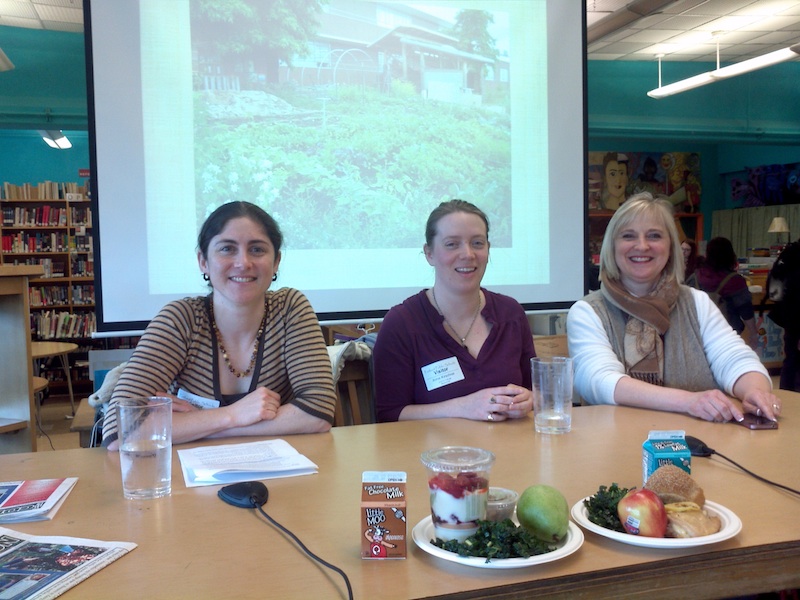
This meal from Madison High School Food Week showcases Portland Nutrition Services perfectly with features lemon rosemary Draper Valley chicken, kale salad from the Madison school garden, NW apples and pears, nutrient-rich fat-free/low-fat milk, and a delicious yogurt parfait with Oregon strawberries from the Willamette Valley (fresh frozen no sugar added). Pictured left to right are Stacey Sobell of Ecotrust, Annie Kirschner from Partners for Hunger Free Oregon, and Gitta Grether-Sweeney, PPS Nutrition Director.

2.     They sweat the small stuff.

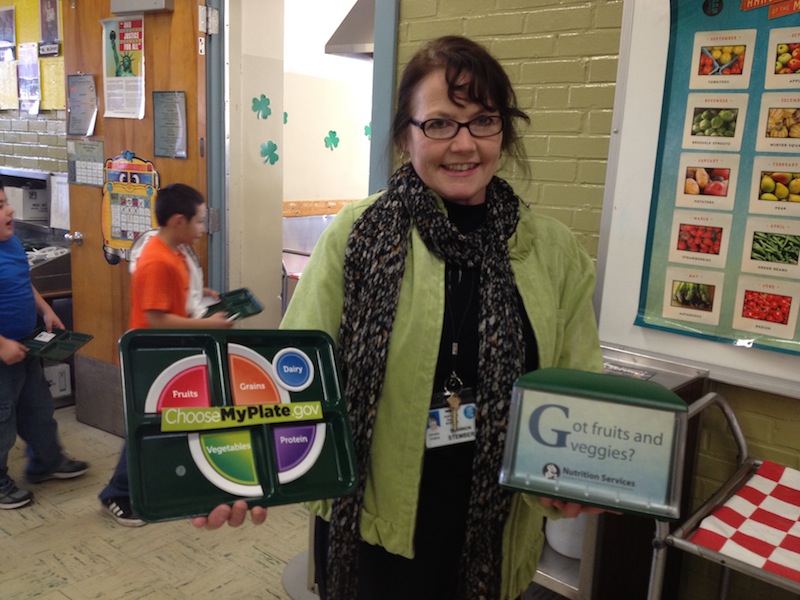
Walk through a school cafeteria with PPS Registered Dietitian Shannon Stember and her eyes take in every detail – entrée presentation, salad bar food safety, and kids eating (or not) the food on their trays. She has helped to make the translation from MyPlate to the new meal patterns make sense for kids using the trays they actually eat on every day.

Like other excellent programs, Portland, Oregon, only needs minimal changes to meet the new USDA meal patterns for schools meals. Looking ahead, they know that the key will be getting real, sometime finicky kids to eat the nutrient-rich options on their trays. Like smart marketers and motivators, they are looking for every opportunity to get nutrient-rich foods onto student trays – and more importantly, into their bodies!!

3.     They make nutrition appealing and easy.

Knowing that it’s only nutrition when they eat or drink it, Portland Public Schools Nutrition Services constantly balances student preferences and nutrition guidelines. They educate children’s palates with new options, like black bean/corn/cilantro salad, while making it easy for kitchen staff to prepare dishes with limited time and equipment. They inspire curiosity through Fresh Fruit and Vegetable snacks in the classroom – and work tirelessly to upgrade the culinary skills of their more than 240 staff members.

Kudos and gratitude to all the enthusiastic school nutrition professionals in Portland – and across the country – who are committed to ensuring that students are well-nourished and ready to learn every day.