Going Green from the Inside Out

Best wishes for healthy Happy St. Patrick’s Day filled with the luck of the Irish and lots of naturally green vegetables. 

  • Want to see how schools are serving delicious GREEN VEGGIES and much more? Follow us on Facebook: School Meals That Rock
  • Want the latest updates and fun tips on GREEN VEGGIES in school and more? Follow us on Twitter: @SchoolMealsRock 
  • Want hundreds of colorful photos of GREEN VEGGIES in school and much more? Follow us on Pinterest: School Meals That Rock
  • Want fabulous posters of GREEN VEGGIES and more for your school or office?       Visit USDA Team Nutrition Dig in Program – and poster page for downloads.
  • One example of fabulous Dig In Posters from USDA Team Nutrition

    One example of fabulous Dig In Posters from USDA Team Nutrition

    Want the latest updates and fun tips on GREEN VEGGIES in school and more? Follow us on Twitter: @SchoolMealsRock 

Kale Chips for 8,000 and Other Farm-to-School Successes

A version of this article originally appeared on The Huffington Post Green on October 14, 2013

The real food deliciousness of Farm to School efforts benefits everyone: The farmers and ranchers who grow food for local districts, school nutrition directors who know exactly where their food comes from, and – most of all – millions of students who enjoy fresh food right on their school trays.

The three pillars of a sustainable farm to school program are generally seen as Cafeteria, Classroom and Community. But there is fourth, equally important C – Champions! Successful farm to school programs are started, nurtured and harvested by champions at every step from the field to table. Here’s how three directors – three very cool school lunch dudes – from Maine to Montana are growing impressive farm to school numbers.

Thanks to Nutrition Services director Tyler Goodwin, students in the Wells-Ogunquit Community School District on the coast of southern Maine have a personal relationship produce on their lunch trays. It comes from the Spiller Farm, just two miles down the road and students help to pick it, clean it and prepare it. During September 2013 trips to the farm, hundreds of school kids picked 15 bushels (450 pounds) of green beans, 18 bushels (900 pounds) of red potatoes and 15 bushels (720 pounds) of apples (enough to supply the entire District for the next several months).

Maine student pick produce in local fields

Maine student pick produce in local fields

In fall 2013, Chef Tyler froze 10 bushels of carrots, also picked by student helpers. The final yield was 450 pounds of freshly picked, lightly steamed, very local frozen carrots for winter meals like veggie stir-fry, peas-n-carrots and candied carrots. Total time from field to freezer was less than four days, with a substantial decrease in overall carbon footprint. The environmental impact is important to the district’s Green Team, headed by 7th grade science teacher Saul Lindauer. The team is learning about and working to support centuries of farming heritage in Wells. According to Goodwin, fresh local produce makes a real difference in cafeterias too. “What I have noticed in all schools is healthier choices being made, kids are automatically selecting the required fruit or vegetable with lunch, and less waste than last year,” he reports.

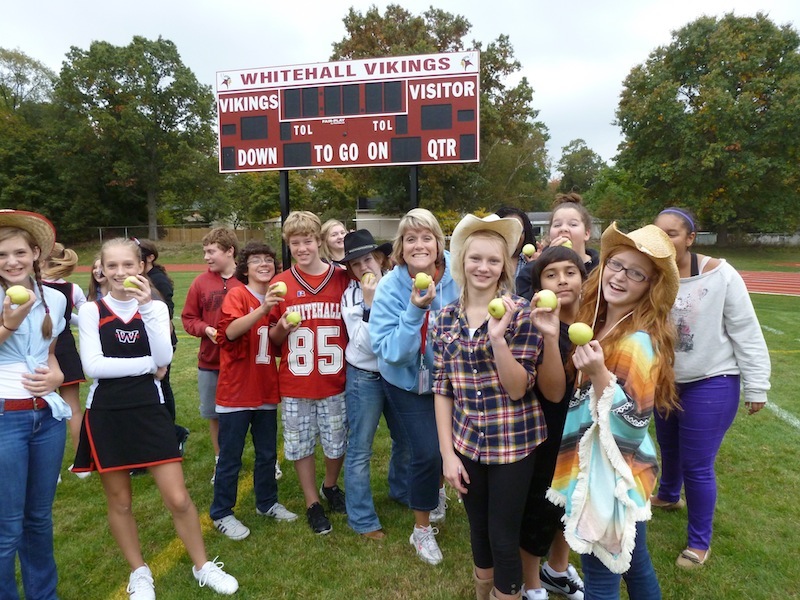
Deep in the apple orchards of Central Michigan, Dan Gorman, Food Service Director in Montague/Whitehall Schools focused on some big farm to school numbers too – world record numbers in this case! On October 24, 2013, he and the districts’ 4,000 students – plus at least 14,000 more in Muskegon County – regained the World Record for the “most people simultaneously eating an apple at one time.” Muskegon County held the world record (9,329) until last May when children in New Zealand schools upped it to 17,064 with the help of an apple company. Now the Michigan apple crunchers are back on top of the world record with 19,087!!
Michigan students love their apples!!

Whitehall, Michigan, students love their apples!!

Promoting healthy snacking, supporting local agriculture and generating record-breaking excitement are just some of Dan’s everyday efforts to bring fresh, local food to kids. When he switched the district’s milk contract to a local dairy that raises its own cows and crops, the farm was able to hire four new workers. In the elementary cafeterias, monthly Harvest Days highlight Michigan fruits, vegetables and herbs. Students get to touch, smell and taste fresh items with their lunch, guided by an adult community member or high school mentor. As chair of the 1 in 21 Education Committee, Gorman is – as always – focused on a much bigger goal. “Going for a world record is as American as apple pie, but the more important goal is making Muskegon county the healthiest county in Michigan by 2021,” he says.

Now, about the kale chips for 8,000: It happened for the second time on October 2, 2013, to celebrate National Kale Day in Missoula County Public Schools, Montana. In 2012, on a ‘dare’ from Jason Mandela of the PEAS (Program in Ecological Agriculture and Society) Farm, Food and Nutrition Supervisor Ed Christensen offered baked kale chips to every student in the district. While not shy about saying his kale chips are “the best,” Ed was impressed by how much the kids liked them. “It’s really pretty simple,” he says. “We use freshly picked kale, toss it with oil, sprinkle with a little salt, and bake slowly.” While olive oil adds nutty flavor and USDA commodity oil works fine, Christensen also likes to use Montana-grown safflower on his kale chips.

Ed Christensen makes kale chips for 8,000

Ed Christensen makes kale chips for 8,000

Kale is big on Christensen’s local veggie list because it’s so hardy, often the last thing harvested from the PEAS Farm. Chips are a great way to serve kale because they are like potato chips to kids. On a recent ‘smack down’ with a tasty raw kale salad, the crunchy chips won hands down. During this year’s Kale-abration, Ed saw savvy 3rd graders crushing the chips onto their pizza. About that pizza, the crust is 100 percent scratch, whole grain made with local Wheat Montana Prairie Gold flour and turkey pepperoni. Missoula schools are currently developing a scratch sauce to incorporate house-grown onions and herbs. Clearly Ed wants to do farm to school as many ways as possible – in a place with a growing season of about four months!!

Being a school nutrition director is a tough enough job without adding all the extra details of a farm to school program. Despite the demands, thousands of directors across the U.S. have stepped up to the plate — or lunch tray — to do what Tyler, Dan and Ed do in their districts. Why? So students can have the freshest, best tasting, most nutritious meals possible and be fit, well-nourished and ready to succeed.

Follow Dayle Hayes, MS, RD on Twitter: www.twitter.com/SchoolMealsRock

Create Healthier Schools with AFHK Grants for Healthy Kids

I am a long time fan of and volunteer for Action for Healthy Kids, which is currently welcoming schools to apply for 2014-2015 School Grants for Healthy Kids. The grants will range from $500 to $5,000 and are designed to help schools create or expand school breakfast programs, pilot universal breakfast programs or enhance their physical activity programs.

In addition to financial support, through funding from its sponsors, AFHK will provide the roughly 1,000 chosen schools with significant in-kind contributions in the form of programs, school breakfast and physical activity expertise and support to engage volunteers. The organization also will provide schools management expertise and support to develop strong alternative and universal breakfast or physical activity programs. Bottom line: Your school will get monies, support and technical assistance – a winning combo!

School Grants for Healthy Kids proven to improve school health environments

Past School Grants for Healthy Kids recipients have great stories to tell. For example: Trimble County Middle School in Bedford, Ky., reports a steady increase in their Universal Breakfast program participation and overall sick complaints/nurse visits down school-wide. Trimble County has also received compliments from the student body and notes that the breakfast program has helped ease a financial burden for families.

Universal Breakfast is a great program. I see the number of students that come through my serving line that are hungry and are not getting healthy meals at home. This is a great way to show that someone does care,” said Jackie Goode, Trimble County Middle School cafeteria manager.

A grant from School Grants for Healthy Kids can do the same for your school.

Grants will be available in select states. Award amounts will be based on building enrollment, project type, potential impact, and a school’s ability to mobilize parents and students around school wellness initiatives. Applications must be filed by May 2, 2014. The deadline will not be extended.

Learn more: If you’re interested for your school, attend an hour-long introductory webinar Thursday, March 20, 2014  at 3 p.m. ET, 2 p.m. CT, 1 p.m. MT and noon PT to get tips for applying. You can register.

Archived sessions also will be available. Once you have all the information you need, start the application process and apply before the May 2, 2014 deadline.

Trimble County Promote School Breakfast

Trimble County Promote School Breakfast

Why You Should Support School Breakfast, Even If Your Kid Eats At Home

It’s National School Breakfast Week and the buzz about breakfast at school is louder than ever this year. I’ve also been hearing pushback from parents who feed their children home – “our family doesn’t need school breakfast, why should we support that program?

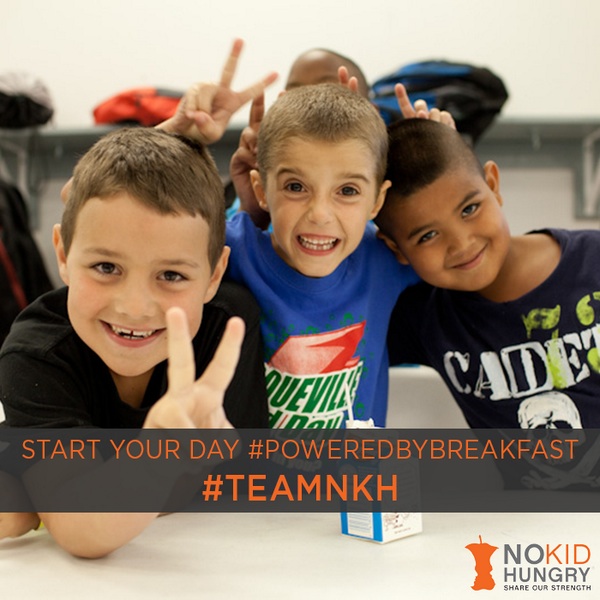
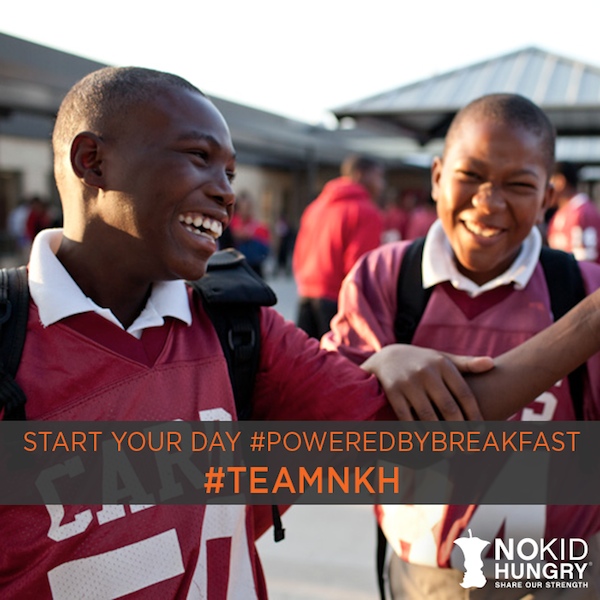
Every student should start the day powered by breakfast

Every parent in America has probably used this phrase many times: “Breakfast is the most important meal of the day.” If you recognize the multiple benefits of breakfast for strong bodies and smart brains, that’s great. If you make certain that your children never leave home without a breakfast of whole grains, fresh fruit and Greek yogurt or backyard eggs, that’s awesome for your kids. Their metabolism got a great kick-start and their brains have the fuel they need to focus on the teacher and learn new information – until lunchtime – every day.

But what about Jane, Johnny, Sam, Suzy and all the other students sitting around your child’s desk or table at school? Did they have a balanced breakfast? Did they have breakfast at all? In fact, did they have anything nutritious since they ate lunch at school the day before? Why should you care what your child’s classmates have or have not eaten? Why should you support a breakfast program at your school even if your kids will never need it?

According to Share Our Strength’s Teacher Report 2013, the answers are quite shocking:

  • Too many children are too hungry to learn. 87 percent of principals see hungry children in their schools at least once a week and 73 percent of teachers have students who regularly come to school hungry because there isn’t enough food at home.
  • Hungry children cannot listen to the teacher because they are listening to their stomachs. When children come to school without a morning meal, it impacts their ability to concentrate, their attention span, and their classroom behavior. In the Share Our Strength report, 90 percent of educators say breakfast is critical to academic achievement.
  • Even if your family is blessed with a perfect breakfast every day, other inattentive, unfocused, under-nourished children can affect your child’s ability to succeed at school. It happens directly when hungry children need more of the teacher’s time -and indirectly when your child is distracted from the lessons at hand.

PoweredByBreakfast-3

The important connection between breakfast and school performance is well known. When standardized tests are given, every school in America tells students to “get a good night’s sleep and eat good breakfast.” Unfortunately, breakfast during test week is too little too late! Children need breakfast every day to get new information and skills into their brains, not just to get them out on test day.

Here are three things that every parent can do to support breakfast, classroom performance and successful schools for every child — including their own:

  • Digest the facts about breakfast and hungry children in America. The 2013 and 2012 Teacher Reports are good places to start. You may also want to Map the Meal Gap in your state or county. A 2013 USDA report estimated that 1 in 5 American children (21.6 percent) live in food insecure homes. In my opinion, it is a moral imperative that we change this fact. Even if you do not agree, think of all the educational problems that hunger causes in classrooms from coast to coast.
  • Explore expert views on the power of school breakfast. Many forward-thinking educational groups understand the breakfast research. On March 3, 2014,
    five leading education organizations and the Food Research and Action Center (FRAC) announced the Breakfast for Learning Education Alliance to encourage schools and states to increase school breakfast participation. The alliance includes the major national associations representing parents (PTA) and virtually everyone who works in schools – teachers, principals and administrators. Honestly, can all these groups be wrong about such a simple and effective program.
  • Advocate for breakfast in your community. Students from every income level benefit from a balanced morning meal every day, whether they eat it at home or school. Fuel Up to Play 60, a national program to improve school nutrition and fitness, has made healthy breakfast choices and effective school breakfast programs a priority. Check out their breakfast “plays” and you’ll find fun ways to get all students more excited about getting a smart start on every day.

While your child may not need a school breakfast program, their friends and classmates may not have that luxury for a myriad of reasons. Breakfast is a simple, cost-effective way for high-performing schools to help every child be well nourished and ready to learn. That’s a strategy that I support as a mom, a Registered Dietitian (RD) and a taxpayer.

March is National Nutrition Month – and a great time to make sure your family is powered by breakfast. My takes on better breakfast bites can be found at Make Time for Breakfast and 4 Tips for Better Breakfasts from Kids Eat Right and the Academy for Nutrition and Dietetics.

PoweredByBreakfast-2

Follow Dayle Hayes, MS, RD on Twitter: www.twitter.com/SchoolMealsRock