Eat. Play. Learn. Q is QUINOA.

To celebrate the publication of Proceedings of the Learning Connection Summit: Nutrition, Physical Activity, and Student Achievement, I’m offering a short daily post during February on the ABCs of the health and academics.

Q is for QUINOA

There weren’t too many competitors for the Q word – and QUINOA has been popular in school breakfast and lunches as well as homes across the country. The versatile, gluten-free ‘pseudocereal’ is actually related to beets, spinach and tumbleweeds.

QUINOA is served in Provo (Utah) Public Schools as Black Bean, Corn and QUINOA Salad and in Windham-Raymond (Maine) Schools in a made-from-scratch Vegetable QUINOA Soup. The new cookbook from Vermont FEED – New School Cuisine Nutritious and Seasonal Recipes for School Cooks by School Cooks – features several yummy QUINOA recipes, including one for Carrot and QUINOA Muffins.

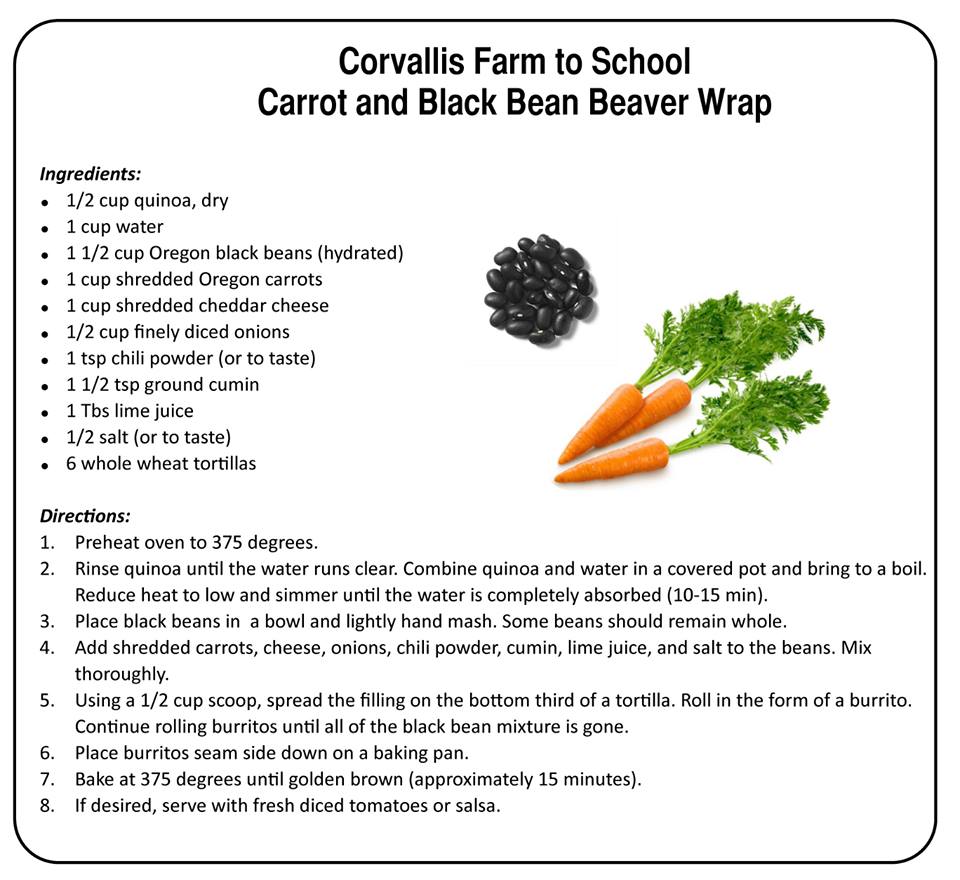
This recipe has been served Corvallis (OR) Farm to School events – and was recently very popular at a Corvallis High School Wellness event. In schools from coast to coast, students get to eat – and learn about – the hottest culinary and nutrition trends.

Corvallis (OR) Farm to School, Carrot, Black Bean, and Quinoa Wraps

Eat. Play. Learn. O is for OLYMPICS

To celebrate the publication of Proceedings of the Learning Connection Summit: Nutrition, Physical Activity, and Student Achievement, I’m offering a short daily post during February on the ABCs of the health and academics.

O is for OLYMPICS

I am truly impressed by the dedication, commitment and love that most school nutrition professionals – or HEROES – have for their jobs and their customers. In a way, it’s rather like the dedication, commitment and love that athletes have for the Olympics. Lunch “ladies” and gentleman race around kitchens and cafeterias every day. Quickly changing menus when school is cancelled, figuring out substitutions when deliveries do not arrive, and then feeding hundreds of hungry children in a matter of minutes.

These every day heroes take the time to learn the students names – sometimes a manager will know the name and something personal about 400 or 500 students. They decorate their cafeterias and lines with artwork to educate and enjoy at the same time. This poster was one of several Olympic posters made by director Gen Armstrong, RD, for the Haines, Alaska, school district during the Olympic Games.

“Instead of changing the menus for the 2 weeks of the Olympics I just looked at the entree or when I was really struggling a condiment (like sour cream for Russia). I then drew their flag, listed how many medals they had going into the games, how many athletes, I then looked up a fact about the featured food, an athlete from there, and finally showed what a school lunch from that country would look like. After they have their day in the display they are taken down and hung around the cafeteria and will remain for the duration.”

Ms. Armstrong deserves a gold medal for her many achievements in the Haines Borough District. She serves Alaskan Farm-to-School produce on the salad bar – and fresh, made-from-scratch, locally-sourced mini crab cakes in the cafeterias. Now, that’s a school lunch that anyone could love. Thanks to Gen and to the thousands of school nutrition heroes for all the meals they serve – right now, somewhere in America, they area feeding the athletes training for Olympics 2018 and beyond. Go USA!

Haines (AK) Olympic Celebration

Haines (AK) Olympic Celebration

Eat. Play. Learn. L is for LUNCH

To celebrate the publication of Proceedings of the Learning Connection Summit: Nutrition, Physical Activity, and Student Achievement, I’m offering a short daily post during February on the ABCs of the health and academics.

L is for LUNCH

We hear lots of talk about breakfast being the most important meal of the day, especially for children in school. And, when we talk about childhood hunger, most of the conversation is again about insuring that food insecure children have access to school breakfast. But, what about school lunch? Is lunch any less important than breakfast at school?

School lunch is just as important for focus, concentration and learning as breakfast – just in the afternoon instead of the morning. More children have access to school lunch than school breakfast, but sadly many children may not have enough time or the right atmosphere to actually eat and enjoy the lunch they are served. Experts agree that students need at least 15 to 20 minutes of seat time for lunch. Unfortunately many children have 10 minutes or less to sit and eat at lunchtime – and often the cafeteria is loud or managed more like a prison with whistles, lights out and silence for bad behavior.

The good news is that some schools are creating Comfortable Cafeterias, which encourage students to socialize and enjoy their lunch – without being pressured to eat or to hurry. I have worked with Montana Team Nutrition on resources for Pleasant and Positive Mealtimes. The goal is make cafeterias inviting places for children to eat – so that the food goes into them rather than into trash cans. It is only nutrition when they eat or drink it!

Just look at the wonderful tray that this student in Bethel, Oregon, chose on the lunch line and consider for a moment how long it will take her to eat it – even without distractions from other students and cafeteria aides! With a a beautiful lunch like this, children need time and encouragement to eat, so they can pay attention and learn in the afternoon.

First Grade Student in Bethel School District, Eugene, Oregon

First Grade Student in Bethel School District, Eugene, Oregon

Eat. Play. Learn. K is for KALE

To celebrate the publication of Proceedings of the Learning Connection Summit: Nutrition, Physical Activity, and Student Achievement, I’m offering a short daily post during February on the ABCs of the health and academics.

K is for KALE

This blog series has been less food-focused that much of my writing – since the goal was to explore more broadly on the connections between academic/school success and overall nutrition/fitness. I want to talk here about kale in a broader ‘symbolic’ sense than about it’s nutrient values or trendy culinary reputation. Although I do have to admit that a vegetable with its own national celebration is pretty cool – more at National Kale Day (where you can now download your own Kale Hero Kit!).

Kale is a hardy and versatile veggie. It’s a successful outdoors in southern winters and a grows great in northern greenhouses during the cold months as well (the photo below is a January posting from FoodCorps Massachusetts). This means that kale is perfect for school year gardens where it gives many children their first taste of dark green leaves. It is versatile in the kitchen – delicious raw in salads, cooked in soups and perhaps, most importantly, as the surprisingly crispy and popular kale chip. An article in the Huffington Post – Kale: Benefits Beyond Nutrition – got me thinking about how much this humble green is helping children learn about growing, preparing and enjoying new foods. Kale is a combination of the ultimate local food – and the gateway to a whole nutrition world.

For more about kale chips in schools, please read my HuffPo article on Kale Chips for 8,000 and Other Farm-to-school Successes by the Numbers.

FoodCorps Massachusetts at the Food Project

FoodCorps Massachusetts at the Food Project

Eat. Play. Learn. I is for INTERNATIONAL

To celebrate the publication of Proceedings of the Learning Connection Summit: Nutrition, Physical Activity, and Student Achievement, I’m offering a short daily post during February on the ABCs of the health and academics.

I is for INTERNATIONAL

With all the current Olympic coverage, I’ve been thinking international school foods and looking forward to International School Meals Day 2014. In promoting the second year of this event, USDA Yibo Wood emphasized the learning connection – facts that bypass any border.

“A hungry or emotional child cannot develop physically, mentally or emotionally. Healthy eating habits provide the optimum mental and physical health for children and, once established, last a lifetime.”

The theme for this year’s celebration is Food Stories. Check out International School Meals Day 2014 and get involved, find resources and share practices.

Speaking of the 2014 Olympics and great food stories, Gwinnett County (GA) Public Schools has a fantastic promotion this week. The Lunch Games has delicious options based on cuisines from Greek and Argentina to Italy and Russia. You can see all four lunches on the Schools Lunches That Rock Pinterest board.

Gwinnett County (GA) Public Schools 2014 Olympic Promotion

Gwinnett County (GA) Public Schools 2014 Olympic Promotion

Eat. Play. Learn. G is for GARDEN

To celebrate the publication of Proceedings of the Learning Connection Summit: Nutrition, Physical Activity, and Student Achievement, I’m offering a short daily post during February on the ABCs of the health and academics.

G is for GARDEN

It this point in the cold winter, it warms my heart to think about school gardens. Of course, I also get a envious when I see Florida school gardens that are green and lush when the snow is nearly a foot deep in Montana!

Why include gardens in talking about the learning connection? Students can learn all sorts of things in a school garden – botany, biology, chemistry, ecology and math to name a few. Growing food also provides the most direct, tangible connection to nutrition. I often say, if they grow it, they will eat it – there really is no better way to teach healthy eating habits than in a garden.

Here are four photos to represent the diversity and similarities of school gardens in the USA – just looking at them makes spring a little bit closer!

February 2014: Mrs. Donna Stoddard's 2nd grade class in Read-Pattillo Elementary, New Smyrna Beach (FL) are growing kale, radishes, sunflowers, parsley, cilantro, peas, sweet onions, carrots, kohlrabi, potatoes and green peppers in their school garden! Lucky students!

February 2014: Mrs. Donna Stoddard’s 2nd grade class in Read-Pattillo Elementary, New Smyrna Beach (FL) are growing kale, radishes, sunflowers, parsley, cilantro, peas, sweet onions, carrots, kohlrabi, potatoes and green peppers in their school garden! Lucky students! Thanks Fresh for Florida Kids!

June 2014: Alaska Elementary School Garden, Thanks Alaska Farm to School!

June 2013: Alaska Elementary School Garden, Thanks Alaska Farm to School!

March 2013: AMAZING lettuce planted, grown and harvested in the "Garden of Learning," Gary A Knox Elementary School, Crane, Arizona

March 2013: AMAZING lettuce planted, grown and harvested in the “Garden of Learning,” Gary A Knox Elementary School, Crane, Arizona

April 2012: University City High School Garden, Philadelphia, PA, an oasis in the middle of the city and my favorite urban school garden.

April 2012: University City High School Garden, Philadelphia, PA, an oasis in the middle of the city and my favorite urban school garden.

Eat. Play. Learn. E is for ENVIRONMENT

To celebrate the publication of Proceedings of the Learning Connection Summit: Nutrition, Physical Activity, and Student Achievement, I’m offering a short daily post during February on the ABCs of the health and academics.

E is for ENVIRONMENT

In the school wellness ‘biz,’ we talk a lot about creating a healthy school environment. In fact, it’s probably safe to say that most of my professional work and a significant portion of my volunteer time has been devoted to promoting a culture of wellness in K-12 schools. A quote from the The Wellness Impact: Enhancing Academic Success through Healthy School Environments captures the key issues.

“… the vital importance of improved nutrition and increased physical activity in creating an environment that enriches students’ readiness to learn.”

So what exactly is a healthy school environment? How can you tell that you are in a healthy environment when you walk into a school? Actually, I think that you can see aspects of a healthy environment before you even get to a school building! Here are just a few of my favorite way to identify a school where students can be fit, well-nourished and ready to learn.

  • Students (and sometimes families) fill the sidewalks as they walk to school.
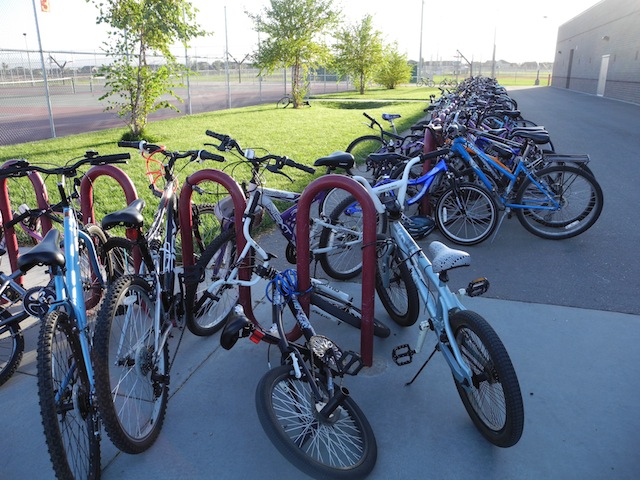
  1. School bike racks are full or overflowing (see photo below from Idaho middle school).
  2. Playgrounds and sports fields are full of children and adults playing together.
  3. Gardens have a prominent place on the school campus.
  4. Wonderful aromas of food cooking/baking/roasting waft through the hallways.
  5. Hallway walls have artwork, signs or markers to encourage physical activity.
  6. Banners or signs identify awards and recognition for nutrition and fitness.
  7. Breakfast is served in the classroom to every child who needs it.
  8. Food presentations are eye-appealing, colorful and customer-focused.
  9. Cafeteria is bright and cheerful; students socializing with inside voices.
  10. Adults are sitting and eating with children rather than patrolling the tables.
  11. Any snack food sales offer many options from MyPlate food groups.
  12. Fun after-school physical activities are available to children of all abilities.

These are just a few of my favorite things in a healthy school environment. What are yours?

Full Bike Racks at Heritage Middle School in Meridian Idaho

Full Bike Racks at Heritage Middle School in Meridian, Idaho

EVERY DAY GOODNESS: Smart Photos of School Meals (Part 2)

Why are we spending so much time on school food photo tips? When people see a few yucky photos of school meals, they think that all school meals are bad. When they see bright, beautiful, colorful foods served in your outstanding programs, they begin to understand all school meals in a different way. Public opinion about school meals is literally in your hands. School Meals That Rock wants the world to see accurate, current, positive images of school nutrition.

That’s why we are sharing tips for better school food photos. Part 1 featured tips on tray color and background; this post offers three suggestions about the food itself.

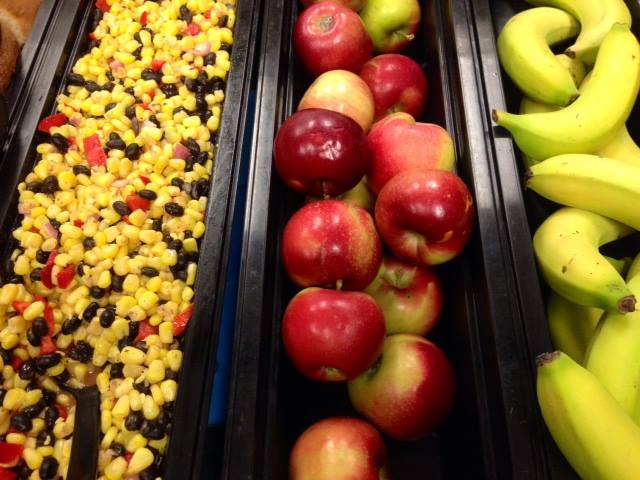
Salad Bar section from Billerica, Massachusetts

Salad Bar section from Billerica, Massachusetts

Tip #4: GO WITH BRIGHT COLORS. There’s no need to always show a complete tray. Look throughout your kitchen and cafeteria for brilliant combinations of colors. This small section of a salad bar has a great mix of red and yellows. It demonstrates the variety of produce options available to student and is very appealing. Thanks to Dina Fordyce Wiroll, Nutrition Services Site Coordinator, Billerica Public Schools for taking it and sharing it. You can learn more about their program by following them at Billerica Schools Nutrition Services on Facebook.

Vegetables from the line in Timpview High School, Provo, Utah

Vegetables from the line in Timpview High School, Provo, Utah

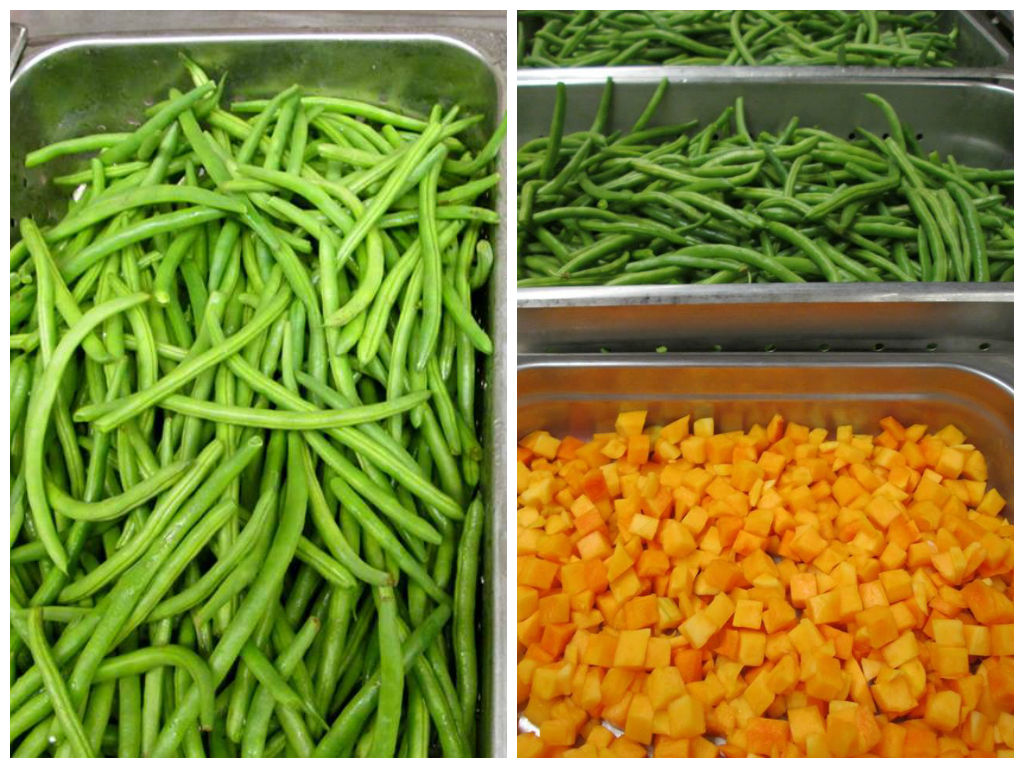
Tip #5: SHOW CONTRASTING COLORS AND SHAPES. Whether on a line or on a tray, contrast is good. These fresh, local green beans look nice by themselves, but see how much more appealing they look in contrast to the steamed butternut squash. Thanks to Colleen Dietz for her amazing collection for school food photos from schools in Provo, Utah. She has done an outstanding job of encouraging staff throughout the district to document excellence in school nutrition. You see learn a lot by following Provo’s work on Facebook at ITS Meals at Provo School District.

Dramatic display of fruits and vegetables from Jackson-Madison County School System, Tennessee

Dramatic display of produce from Jackson-Madison County School System, Tennessee

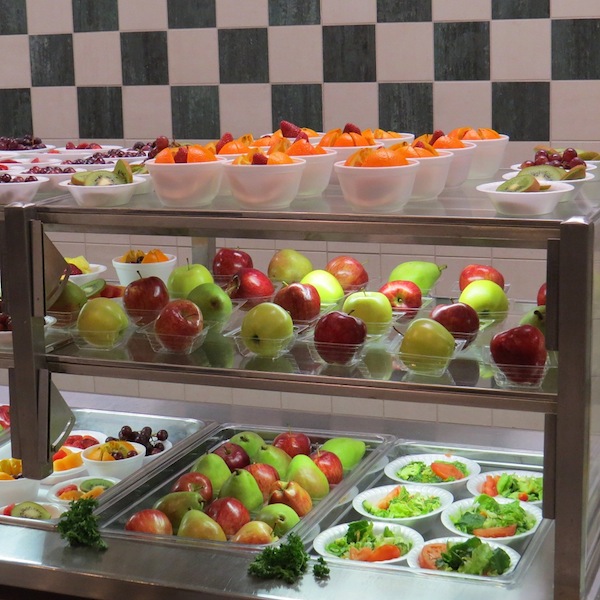
Tip #6: SHOW LAYERS OF COLOR. Multiple shelves in a cafeteria line can be an impressive way to display food – and to encourage students to take and eat items. Layers also make dramatic photographs, especially when they are filled with bright colors. Susan Johnson, School Nutrition Director, from Jackson-Madison County School System in Tennessee, share some knock-out photos with us. This one is from Liberty Technology Magnet High School, where some of the vegetables are grown in a hydroponic greenhouse.

EVERY DAY GOODNESS: Smart Photos of School Meals (Part 1)

School lunch photos are back in the news. First, there was the story about the FedUp campaign on NPR’s The Salt. My reaction – and their response – are at What School Meals REALLY Look Like Today. Now, USA Today wants to know “What does your school lunch look like?” If you believe, as I do, that media coverage has been skewed to outdated and inaccurate images of school meals, there is something that you can do – something that you must do.

It’s time to flood social media with gorgeous photos of real school meals – the EVERY DAY GOODNESS that is prepared in your kitchens and served in your cafeterias and classrooms! A smart, beautiful photo is worth a thousand words – and thousands of views. That’s why School Meals That Rock is featuring SMART TIPS FOR PHOTOS THAT ROCK. Get your Smartphone or camera ready – and start snapping!

TIP #1: TAKE LOTS OF PHOTOS. Seriously, in order to get great photos that do justice to your great meals, you have to practice. So, just do it today. Take lots of photos and delete all of them if they are not as good as you would like. The only way to get good at taking photos is to practice, practice, practice. There are tons of photo ops in every school kitchen and cafeteria – check out the photo gallery at ITS Meals at Provo School District for tons of examples.

Food Day 2013 tray from Decorah, Iowa

Food Day 2013 tray from Decorah, Iowa

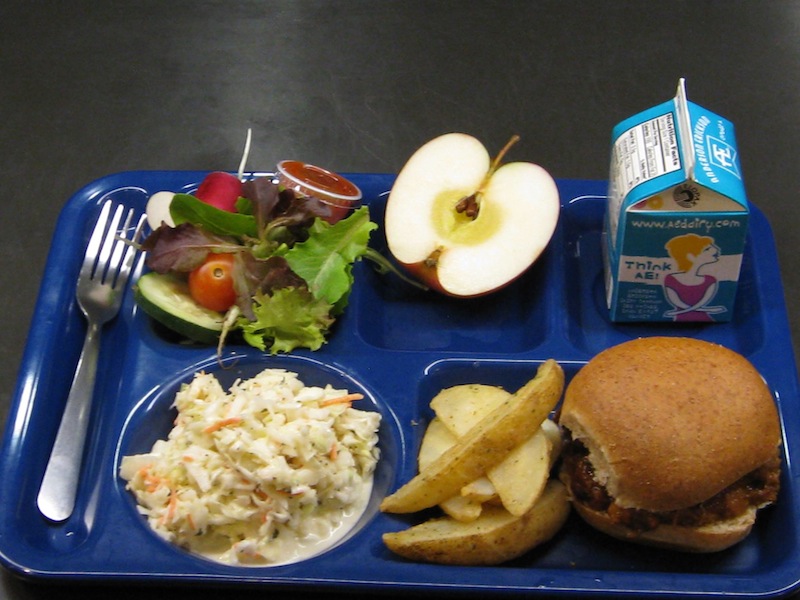
Tip #2: USE A SOLID COLOR TRAY. Deep blue, green and red seem to compliment most school foods best. Natural and black can also work well. Steer away from swirled colors and pastels. Very few foods look delicious on mint green or pink. If you don’t have the right tray, borrow or purchase one to use for daily photos. If you use plates instead of trays, show your meals on plates. The photo above – from a lunch of locally-sourced foods served in Decorah Community Schools in Iowa – rocks for many reasons: The tray color is just one of the them. The meal below may meet all nutrition standards, may be delicious and may even include local foods, but it is hard to see the food for the swirling blue and white colors.

Swirled colors make it hard to showcase delicious food

Swirled colors make it hard to showcase delicious food

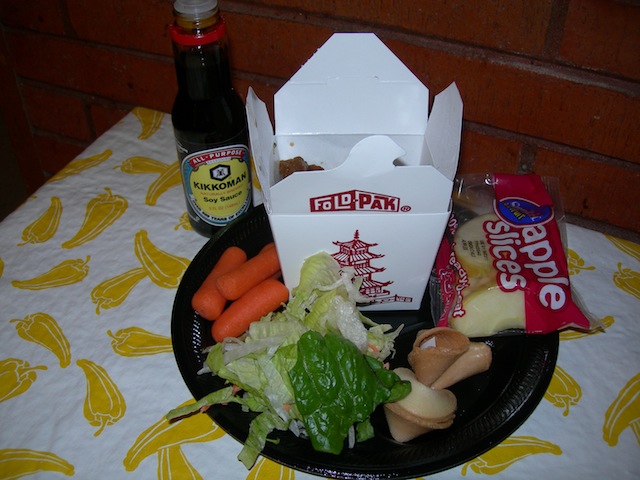
Tip #3: KEEP BACKGROUND SIMPLE. Help the viewer focus on the food by eliminating distracting background patterns. One of the best backgrounds is a clean stainless kitchen counter or cafeteria table. While the meal below has some great options, there are too many districting patterns in the background, plus we cannot see what food is in the box. There is also no reason to include the bottle of soy sauce – a carton or bottle of milk would be much better.

Too many patterns in the background distract from the food

Too many patterns in the background distract from the food

BOTTOM LINE: If you want the world to have a more accurate, current and POSITIVE image of school meals, YOU have to share the EVERY DAY GOODNESS in your cafeterias.

What’s the Real School Lunch News? 31+ Million American Children Get More Vegetables

What’s really sad about the recent article on the state of U.S. school lunch from the Fed Up campaign is that is so-five-years-ago. Using out-of-date statistics, misleading photos, and images that were not even from high schools, this campaign fails to expose the real truth about school lunch today – that it is awesome and kids are eating it up!

Personally, I’m fed-up with reports on school lunch that ignore the real revolution in cafeterias. Where have these school lunch critics been? Clearly not dining in the districts that are featuring produce from schools gardens – or doing farm-to-school, boat-to-school (in AK, OR and NH), and Montana’s recent beef-to-school campaign. What’s really happening in school lunch is that the nearly 32 million students who eat it daily are getting an incredible variety of often local, increasingly organic produce, lean proteins, whole grains and low-fat dairy products. According to the savvy school nutrition directors who observe their teen customers closely, they are eating it all up!!

Here’s a taste of what’s really happening with teens and school lunch in five Western districts of all sizes and demographics. It’s our first-in-a-series tour from coast-to-coast showcasing School Meals That Rock – today, with a special focus on teens and veggies.

In suburban Lake Stevens, Washington, Schools, just west of the Seattle, Calavero Mid-High piloted a “Build Your Own Salad Lunch” last spring and they now serve 65+ a day. They are expanding this concept to all middle/high schools in October: Students order a custom salad built from lean diced meats, shredded cheeses or seeds for protein, croutons or whole wheat bread-sticks for grain, and a colorful selection of fresh veggies (often local) and dried fruits.

Veggie toppings for a "Build Your Own Salad Lunch"

Lake Stevens veggie toppings for a “Build Your Own Salad Lunch”

Mixed salad lunch in a bowl

Lake Stevens customized salad lunch in a bowl

Down I-5, in Eugene, Oregon, Bethel School District, has developed a very impressive Harvest-of-the-Month program. Willamette Valley apples, pears, melons, carrots, bok choy, greens and much more show up on Bethel menus, in sandwiches and throughout variety bars (at least nine different vegetable choices daily at all grade levels).
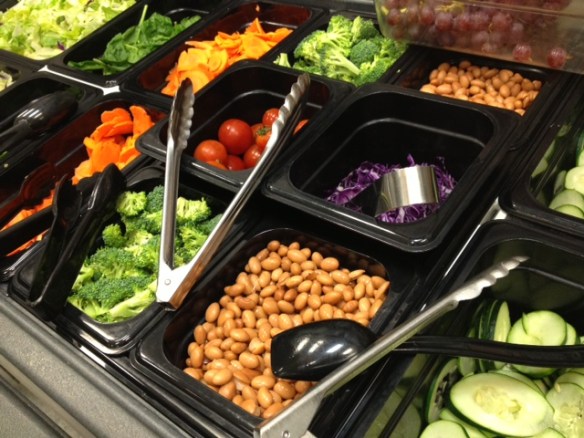
Variety bar - at least nine veggie available daily

Willamette High School variety bar with regular farm to school options

Bethel Nutrition Services Summer Meal Program Sandwich

Bethel Nutrition Services Summer Meal Program Sandwich

In the Solvang, California, Viking Café, Chef Bethany Markee leads a real school food revolution, where they offer a made-from-scratch hot lunch along with grab-n-go options (entrée salads, wrap sandwiches or vegetarian cold items). Thanks to a partnership with Santa Ynez Valley Fruit and Vegetable Rescue, the Viking Café is able to regularly serve fresh, organic produce and thanks to a new school herb garden, the seasonings will soon be very local as well.

Solvang Grab-n-Go Salads

Solvang Grab-n-Go Salads

Solvang produce bar often features "rescued" veggies

Solvang produce bar often features “rescued” veggies

Across the mountains in the Provo, Utah, Schools, Jenilee McComb, Director and Colleen Dietz, Assistant, have made a commitment to freshly prepared, locally sourced meals in this mid-size district just south of Salt Lake City. They proudly lists the farms and farmers who grow food for their kitchen, so that Provo students know where their food comes from – and taking a few extra seconds to make something look more appealing to the eye has made all the difference.

Provo Whole Wheat Spaghetti with Homemade Marinara

Provo Whole Wheat Spaghetti with Homemade Marinara

Provo Homemade Roast Pork and Mashed Potatoes

Provo Homemade Roast Pork and Mashed Potatoes

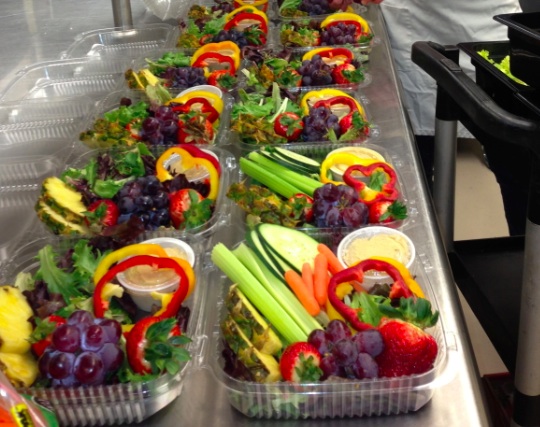
Up in Kalispell, Montana, Public Schools, another medium-sized district close to the Canadian border, Jennifer Montague agrees that presentation and freshness are the keys to getting teens to eat more fruits and vegetables. She believes that young people are discerning customers and they will choose fruits and vegetables if they look appealing and taste good on a regular basis.

Kalispell Hummus Grab-n-Go Salad
Kalispell Hummus Grab-n-Go Salad

Kalispell Rainbow Grab-n-Go Salads

Kalispell Rainbow Grab-n-Go Salads

I am all for getting teens – and even younger students – activated to improve school meals. That’s exactly what the Fuel Up to Play 60 and Alliance for a Healthy Generation programs have been doing for years – with great success. In fact, we have reached the tipping point in school nutrition – and it’s time to use photos like these to inspire lagging districts to make changes.

If you really want to do something, there is no need to use old data and misleading photos. Let’s spend our time showcasing what’s possible and support all school nutrition professionals in serving meals they way districts like Lake Stevens, Bethel, Solvang, Provo and Kalispell are already doing. Jennifer Montague said it best: “If you build it well, they will eat it.”